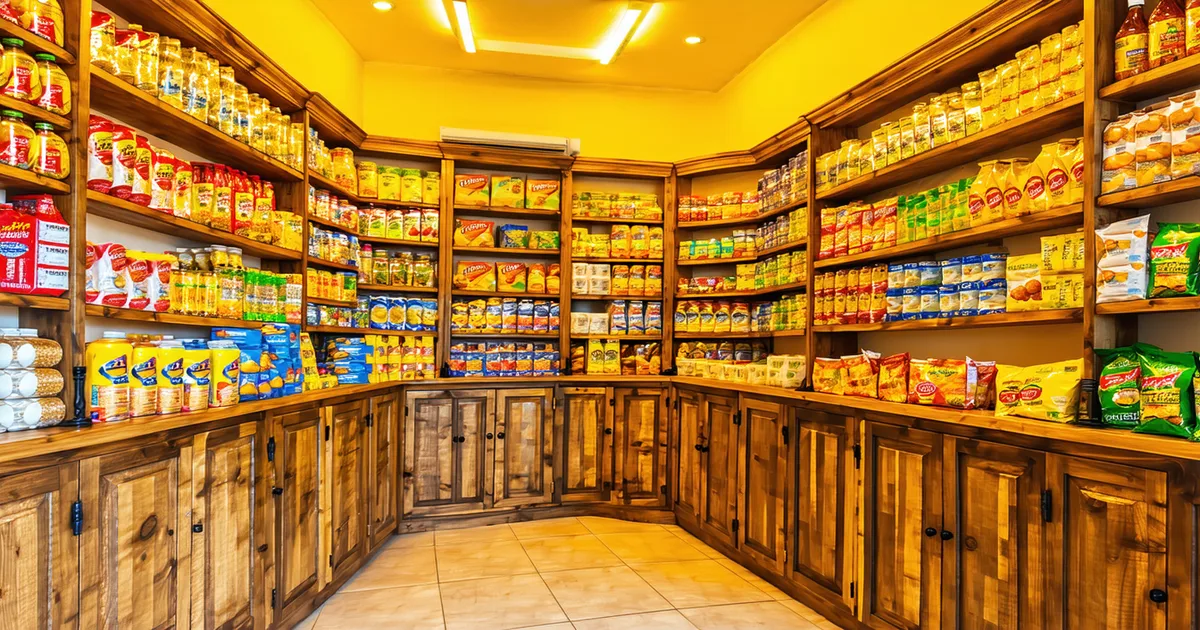
Traditional trade channels — the baqala in the Gulf, the baqqâla in Egypt, the dukkan in the Levant, the small independent grocery that sits at the corner of almost every residential block across MENA — do not price the same way modern trade chains do. This is not a defect. It is a structural feature of how these stores operate, and any FMCG brand pricing strategy that treats modern trade prices as representative of the full market is working with an incomplete picture.
How Traditional Trade Pricing Works in Practice
Modern trade chains set shelf prices centrally, update them through system-driven processes, and apply promotional prices within defined windows governed by trade investment agreements with brands. The price a consumer sees in a large hypermarket is — with some variation for promo execution — a managed price set at the buying office level.
A baqala owner sets their price based on what they paid the van sales rep or the wholesaler, plus their preferred margin, plus their read of the neighbourhood and what their regular customers will accept. They may know what the nearby supermarket is charging — particularly if customers tell them — but they are not constrained by it and their cost input is different. A van sales route that visits a cluster of traditional trade stores on a particular day typically sells at the distributor's recommended price, but there is meaningful variation in how individual store owners mark up from there.
In the Gulf, the traditional trade baqala tends to carry a narrower SKU range than a supermarket, but in categories like confectionery, soft drinks, single-serve personal care, and tobacco, the baqala serves purchase occasions the supermarket does not — the impulse purchase, the late-night buy, the child's snack without a grocery trip. These purchase occasions carry a different price tolerance. Consumers buying a 200ml soft drink at a baqala at 10pm are not cross-referencing the supermarket weekly promotional price. The price elasticity assumptions that apply to a weekly grocery basket do not apply to a baqala impulse transaction.
The Price Corridor Between Channels
Across Egypt and Jordan specifically, field data consistently shows a price corridor between modern trade and traditional trade for the same SKU. The magnitude varies by category and by market, but the direction is almost always the same: traditional trade prices run higher on average than modern trade prices for branded FMCG.
This is not surprising when you consider the structural factors. Traditional trade stores buy at higher unit costs than large chains (smaller volumes, less negotiating leverage, and often going through a distributor rather than buying directly from the brand). Their stock rotation is lower, meaning there is less scope to absorb a thin margin on fast-moving items. Their operating cost per square meter can be high in urban locations even if total overheads are modest. And they carry the convenience premium — availability at unusual hours, proximity to the buyer's home, no parking or checkout queue.
For personal care categories in Cairo, the price differential between the same 250ml shampoo SKU at a large modern trade chain versus a neighbourhood baqala has ranged, in our field observations, from approximately 8% to 20% higher in traditional trade — with the upper end of that range appearing more often during inflationary periods when the baqala owner has adjusted their selling price before the modern trade chain has run its next system price update.
What This Means for Brand Pricing Strategy
Most brand pricing strategies in MENA are built primarily from modern trade price data — either from scanner panels where available, from trade investment records, or from periodic price checks run by the brand's own sales team at modern trade locations. The traditional trade price reality is frequently unknown or estimated.
This creates at least three strategic blind spots. First: if a brand's modern trade price is anchored too low relative to the market, traditional trade may be pricing the brand at levels that undermine its positioning — or conversely, are creating a grey market dynamic where consumers prefer to buy at modern trade because the price gap is visible to them. Second: competitive price moves by a rival brand in traditional trade can erode velocity in that channel without appearing in any modern trade price monitoring. A competitor that runs a van sales promotion through traditional trade at a discounted price point is effectively running a price test that the brand will not see unless someone is actually in those stores. Third: for brands setting recommended retail prices (RRP), the gap between the RRP printed on-pack and what the baqala charges is often larger than assumed. A printed RRP that was set against modern trade competitive context may be irrelevant to traditional trade pricing dynamics.
Monitoring Traditional Trade Prices: The Practical Difficulty
We're not saying traditional trade price monitoring is straightforward — it is not, and any intelligence provider claiming otherwise should be asked about their methodology. The challenges are real: store universe definition (how do you determine which stores to visit when there is no comprehensive register of traditional trade outlets in most MENA cities?), van sales pricing variability (the price a store paid may differ from the price they charge, and the store owner may not share their purchase invoice), and the time cost of covering a statistically meaningful sample of a fragmented channel.
The approaches that produce usable data typically involve a defined store panel — a selected set of traditional trade stores visited consistently on a defined cadence — rather than an attempt at comprehensive coverage. A panel of 40 to 60 traditional trade stores per city, selected to represent different store types and neighbourhoods, visited bi-weekly, with structured price capture for a defined SKU list, generates data that is directionally reliable enough to inform strategy. It is not a census; it does not replace a full market study. But for a category manager asking "is my brand priced where I think it is in traditional trade?", a well-designed panel gives a much better answer than extrapolating from modern trade data alone.
The Ramadan Effect on Traditional Trade Pricing
Ramadan changes the dynamics in traditional trade in ways worth noting explicitly. Traditional trade stores in MENA see elevated footfall in the hours before Iftar (the evening meal breaking the fast) and after Tarawih prayers. Demand concentrates into specific categories — dates, juices, ambient food staples, dairy products — with a speed and intensity that can clear a baqala's stock of certain SKUs within a single evening. This creates both an OOS dynamic (the store runs out before the next delivery) and a price dynamic (some store owners in very high-demand locations will hold prices for regular customers but charge higher prices for less regular buyers, a practice that does not appear in any structured price capture).
The Ramadan pattern also shifts the balance between channels in some FMCG categories — modern trade captures more basket spend during daytime hours (when consumers are preparing for Iftar), while traditional trade serves the immediate-need purchase throughout the evening. A brand that benchmarks its Ramadan pricing performance primarily against modern trade sell-through may be missing the traditional trade dynamics that are shaping actual consumer accessibility.
The traditional trade channel is not a residual channel in MENA FMCG. In Egypt, Jordan, and Lebanon, it accounts for the majority of unit volume in most FMCG categories. Treating it as a pricing afterthought is a category management error that compounds over time as more sophisticated competitive intelligence reveals what is actually happening there.
The practical starting point for any brand that has not systematically monitored traditional trade prices is to define a manageable store panel — a set of representative outlets across a target geography — and establish a baseline price capture at the SKU level before making any pricing decisions. Even a modest panel of 30 to 50 stores visited twice monthly generates enough signal to identify where the channel premium is, whether it has shifted over the prior quarter, and whether competitors are moving differently from you in that channel. That data does not exist until someone collects it.
Getting that first baseline is the hardest step. Once it exists, the comparison compounds in usefulness each quarter. A price corridor that was running at 12% higher in traditional versus modern trade in Q1, and widens to 18% by Q3, is a signal that either your distributor's margin structure has drifted, or that a competitive pricing move in one channel is creating an arbitrage that consumers — or small wholesalers — are beginning to notice. Both scenarios are actionable if the data is there; neither is visible without it.